
World’s first full-scenario robot hotel for Greater Bay Area, China
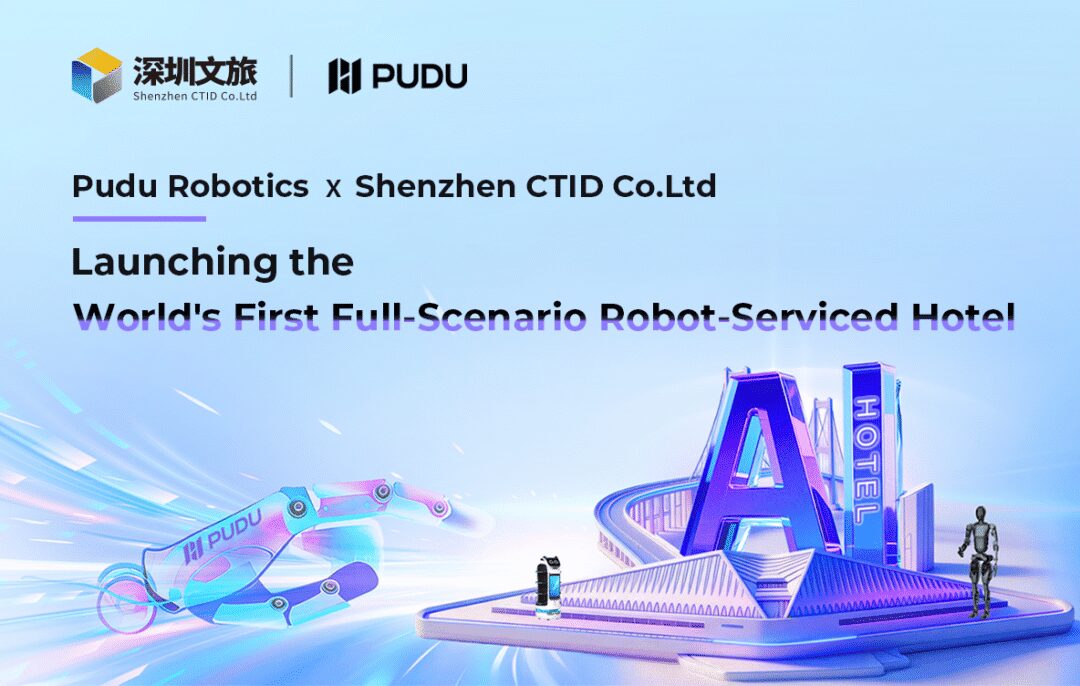
Pudu Robotics, a global leader in commercial service robotics, and Shenzhen Culture & Tourism Industry Development Co. Ltd (Abbv. Shenzhen CITD Co. Ltd) have signed a strategic cooperation agreement to develop the world’s first full-scenario robot-serviced hotel on the West Artificial Island of the Shenzhen-Zhongshan Link, one of the most ambitious infrastructure projects in the Guangdong-Hong Kong-Macao Greater Bay Area in China.
As a next-generation hospitality destination, the hotel will incorporate robots into all key service scenarios, such as guest welcome, room delivery, housekeeping, restaurant service, and guest assistance. The project is one of the largest deployments of robotics in a real-world hospitality setting, utilising embodied AI and multi-robot teamwork.”This collaboration represents an important step toward large-scale deployment of embodied intelligence in premium hospitality environments,” stated Cong Guo, Pudu Robotics’ Co-founder and CTO. “It also provides an opportunity to explore new service models where AI and robotics work together to deliver intelligent, end-to-end experiences in the real world.”
A Global Landmark For The Future Of Hospitality
The Shenzhen-Zhongshan Link is widely recognised as one of the world’s most complex cross-sea transportation systems, combining bridges, tunnels, artificial islands, and underwater interchanges into a single engineering marvel. As a critical gateway connecting key cities in the Greater Bay Area, the West Artificial Island offers a one-of-a-kind platform for showcasing next-generation technologies to visitors from all over the world.
Pudu Robotics and Shenzhen CTID Co. Ltd will implement the project in stages, gradually incorporating advanced robotics and AI capabilities to build a new worldwide benchmark where hospitality, tourism, and intelligent automation merge. The project will run until 2030.
According to the project plan, the hotel will begin a gradual deployment this year. A trial operation is set to begin by the end of 2026, with selected guest rooms and robot-powered services made available to the general public. Early visitors will be among the first to enjoy a seamless hospitality trip powered by robotics, from automated greeting and intelligent check-in to autonomous in-room delivery services.
A Preview of the Hotel of Tomorrow
Pudu Robotics transformed the signing ceremony into a live demonstration of future hotel operations, displaying a broad range of robotic technologies that work together in a hospitality scenario. Guests had the opportunity to experience autonomous retail and delivery with FlashBot’s intelligent vending technology, which automatically retrieved and delivered beverages in response to mobile orders. The PUDU T300 showed heavy-duty luggage transport and autonomous lift interaction, showcasing its 300-kilogram payload capacity.
Meanwhile, the PUDU CC1 Pro and PUDU MT1 cleaning robots cleaned the venue in real time, showcasing AI-based garbage identification and autonomous floor maintenance. BellaBot Pro served visitors freshly brewed coffee while communicating with them via voice and lighting effects, and KettyBot Pro provided beverages and nibbles throughout the event while showing event information on its advertising screen.
The demonstration finished with interactive performances by PUDU D5, which demonstrated how robotics can generate interesting and unique visitor experiences beyond operational efficiency.
From Individual Robots to Fully Connected Service Ecosystems
Unlike traditional smart hotels, which rely on separate automation tools, this idea is based on a fully integrated robotic service ecosystem. From arrival and check-in to room service, dining, housekeeping, and lifestyle amenities, robots will work collaboratively across the entire guest journey, delivering a seamless and highly personalised hospitality experience.
By integrating multiple robot types into a unified operational framework, the hotel will enable continuous, autonomous service throughout its public spaces, guest rooms, and back-of-house operations—establishing one of the industry’s first truly end-to-end robotic hospitality environments.
Together, these capabilities move beyond isolated automation.
The Technology Behind the Experience
Powering the hotel’s intelligent operations is Pudu Robotics’ embodied intelligence foundation model, PuduFM 1.0, together with PuduAgent, the company’s general embodied AI agent platform.
Pudu Robotics has pioneered the introduction of advanced autonomous driving methodologies into indoor robotics, building a unified end-to-end software and AI architecture based on Vision-Language-Action (VLA) models and world-model-driven navigation technologies.
This architecture enables robots with different physical forms and responsibilities to operate from a shared intelligence framework. Reception robots can understand gestures and social interactions, delivery robots can autonomously optimise routes, and cleaning robots can dynamically adapt to changing environments—all while leveraging the same core AI capabilities.
By allowing knowledge and intelligence to be transferred efficiently across different robot categories, Pudu’s platform significantly accelerates product development and deployment while ensuring a consistent user experience across diverse scenarios. The result is a new approach to robotics that combines scalability, adaptability, and operational efficiency at unprecedented levels.
Currently, Pudu offers four major product lines: service delivery, commercial cleaning, industrial delivery and general embodied AI. Its solutions are widely deployed across industries such as retail, hospitality, manufacturing, real estate and property services, healthcare, entertainment and sport, education, and public services.
To date, Pudu Robotics has shipped over 130,000 units globally, with a presence in more than 85 countries and regions.
Picture Source: Pudu Robotics
———————————————————————————————–