
Makimoto Flows, a speech AI pipeline visual builder.
Toku expands its open-source initiative
Within its open-source conversational AI initiative, Toku Ltd. (SGX: TKU), a Singapore-based AI-powered customer experience (CX) platform, has introduced Makimoto Flows (“Flows”), a visual builder where developers put together speech AI pipelines block by block and test each step on a recorded call.
To create a voice AI pipeline, developers connect blocks on the Flows canvas and test each stage separately. The Summarise block creates a topic and brief synopsis from the transcript, the Transcribe block uses Kawa to convert audio into text, and the Tags block categorises each call into seven categories, including customer sentiment.
From transcription to analysis, developers may observe the audio flow and manage the connections and operations of each step. Audio, transcripts, and the ensuing analysis remain in Singapore since every block is conducted there.
These blocks may be combined with a single click using the Chained Analysis beginning template, and developers can modify any block and run it again to compare outcomes.
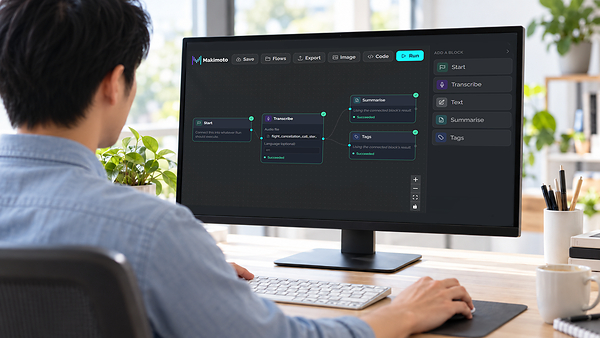
Every block corresponds to a Makimoto API endpoint, and any flow can be exported as executable Python code, allowing developers to incorporate the same features into their own programs for applications like call triage and recaps.From the models they employ to the connections between each stage, developers should be in charge of how their speech AI operates. That is Makimoto’s guiding principle. They can create a pipeline, run a recorded call through it, and see what each step creates before anything reaches their clients thanks to Flows, which puts the orchestration layer in front of them. Models will continue to evolve. According to Thomas Laboulle, founder and CEO of Toku, “the ability to compose them and know where they run is what lasts.”
Flows goes beyond transcription and expands upon the composable framework Toku established when it unveiled Makimoto in April 2026. The transcription layer was established by Kawa, which was published on schedule on July 1, 2026, using an API hosted in Singapore. Summarisation and tagging endpoints followed in September, and Flows now allows developers to construct them visually.
In order to provide developers more flexibility over the processing of recordings prior to transcription, Makimoto intends to include audio preparation blocks, beginning with noise filtering.
Makimoto enables long-term innovation opportunities throughout the Group’s AI roadmap and enhances Toku’s current customer experience platform by combining open-source development with enterprise-grade deployment.
Developers can register for a free account at makimoto.ai, launch the Chained Analysis template, and use one of their own call recordings or a sample recording. Each account comes with 1,000 free minutes. The Makimoto team receives feedback straight from the portal.
Flows is currently available at makimoto.ai.
Picture Source:Toku Ltd.
————————————————————————————————-