
Getting a HK space industry isn’t rocket science
Mahesh Harilela on a historic chance to front China’s space economy
Hong Kong has a unique opportunity to help the world “derisk some of the geopolitical strains” in the rapidly evolving space industry, while enabling countries to tap into China’s growing capabilities in satellite technology and related services, according to Mahesh Harilela.
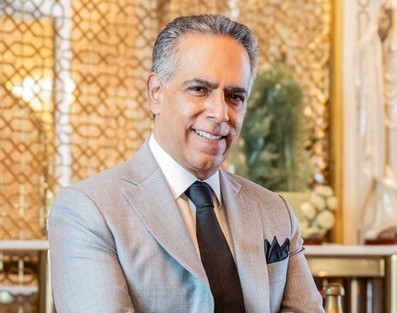
Mr Harilela, a member of one of Hong Kong’s most prominent business families, is a co-founder of SpaceHK, a policy advocate for Hong Kong becoming a space industry hub. Mr Harilela, who is also Family Council Convenor, The Harilela Group, was speaking in an exclusive interview with innovationhongkong® about the city’s potential role in the global space economy.
Rather than competing with established launch centres, Hong Kong could serve as a bridge between China’s aerospace ecosystem and countries seeking access to satellite technologies, financing, insurance and regulatory expertise, he argued.
The United States is “very good at launching rockets,” and has made their cost “fantastically low,” Mr Harilela said. China, however, “is the only country that is able to provide the upstream technology” for use by other countries that want satellite-based data-gathering capabilities, but might not have their own rocketry and space-industry sector.
What is often overlooked, Mr Harilela suggested, is the growing commercialisation of space via low-Earth-orbit satellites and the data they generate for a wide range of civilian applications.
For example, Indonesia – an archipelago with hundreds of islands – needs to monitor its coastline for underwater volcanic eruptions, earthquakes, tsunamis and other risks. The “time” and cost of doing that via underwater sensors would be prohibitive.
“They need to launch satellites,” Mr Harilela stated. “But Indonesia doesn’t have the tech, they don’t have the capability of launching a rocket into space. We, in Hong Kong, can help them go to China to create a joint venture.”
China’s “supply-chain capability” means it can help countries develop their own satellite projects or payload programmes “at a low cost,” he noted. “Hong Kong can be that supply-chain management gateway.”
Hong Kong’s not going to “launch rockets” from the city, he added. “We’re not capable of manufacturing all the aerospace components.” Nonetheless, the city’s “intellectual prowess will allow us to use the resources that are available in the [Guangdong-Hong Kong-Macau] Greater Bay Area, as well as using Hong Kong’s international outreach,” the entrepreneur suggested.
Business jurisdiction
China “doesn’t need” overseas private-sector capital to develop its space-industry capabilities. Nonetheless Hong Kong – as part of China, but with its own legal system and own system for intellectual property (IP) – can help other places.
Mr Harilela said that once China has reusable rocket launchers – with testing ongoing – costs of such launches will reduce. That might create a scenario where China permits more countries than currently, to use its payload systems. It would also – he suggested – give such countries “sovereign control” of the data gathered on their behalf.
By partnering with China on satellite-data projects, the information gathered could benefit a country’s national development in various areas, such as agricultural planning, fisheries, coastline protection, and tourism, as well as geological alerts, the SpaceHK co-founder suggested.
Beyond technology and data sovereignty, Mr Harilela believes Hong Kong’s established financial system could become a critical component of future space-sector growth.
Taking Indonesia’s satellite needs as an example, “maybe Hong Kong can provide intelligence, consultations” or if an Indonesian entity wants “to list an IPO,” then that could be resourced via Hong Kong.
According to Hong Kong Exchanges and Clearing, in 2025 Hong Kong was the world’s leading market for initial public offerings (IPOs) across multiple sectors, raising US$37.4 billion via 119 listings, including two of the five largest IPOs globally.
A key question was how Hong Kong could “utilise” that fundraising capability to serve growth sectors beyond the Hong Kong and Chinese-mainland markets. Such partnerships on space-industry projects could be one route, Mr Harilela told innovationhongkong®.
Possibly even before that, the “lowest hanging fruit” for Hong Kong would be “insurance and regulation” for the space industry, he stated, as the city has “all the major insurance companies, as well as the financial institutions”.
He said the insurance premium for launching a Chinese rocket is currently mostly handled through Chinese-mainland insurance companies. Premium costs might be reduced, were Hong Kong able to participate on a “syndication” basis with the city’s insurance sector on such coverage.
“What we can do for China is build the financial highway that helps to also empower” countries, including ASEAN [Association of Southeast Asian Nations] members, regarding their aerospace ambitions, Mr Harilela noted.
GDP contribution
For the entrepreneur, the potential opportunity extends beyond individual projects. “The insurance companies in Hong Kong can actually play a huge role” rather than only looking at life insurance or medical insurance. “As they amplify or grow” in the space sector, that “contributes to Hong Kong’s GDP [gross domestic product],” he stated.
The SpaceHK co-founder estimated that the development of a local space-services ecosystem could generate billions of dollars in economic activity. “We look at a potential GDP contribution of 3 percent to 5 percent” from the space sector, he added. “For the short term we’ve said it could represent a US$10 billion pipeline to Hong Kong in the next three years.”
Hong Kong is already contributing technology and expertise to China’s space programme, Mr Harilela noted. These included camera systems developed by researchers from Hong Kong University (HKU), for China’s Chang’e 7 mission; and the “Hong Kong Operation Robot” project developed by a team led by the Hong Kong University of Science and Technology, for China’s Chang’e-8 moon mission. Hong Kong’s first female taikonaut, Lai Ka-ying, is an alumna of HKU. She flew with the Shenzhou 23 mission that launched on May 24, 2026, to the Tiangong space station.
Hong Kong also has the potential to serve Asia and beyond, as a space-regulatory jurisdiction similar to Luxembourg’s role for European aerospace, Mr Harilela suggested. The scale of growth in the global space sector underpins the case for the city to develop a more formal role, he argued.
Worldwide in 2025 alone, 4,510 objects were launched into Earth orbit or beyond, according to the United Nations Office of Outer Space Affairs. The United States was responsible for 3,708 of the declared ones in 2025, and China was in second place, with 374. The U.S. Space Force tracks more than 16,000 active satellites, and tens of thousands of ‘debris pieces’. In December 2025, China filed applications with the International Telecommunication Union, a United Nations body that allocates spectrum in space, for more than 200,000 satellites.
Mr Harilela says such a climate creates an opportunity for Hong Kong to develop a “space industry office”, to create a clear framework to support aerospace business, including a “regulatory platform” with “protocols,” and which offers an insurance service. There could also be a registry for spacecraft and space objects, in the manner of registries for aircraft and ships.
SpaceHK, family offices
The other founders of SpaceHK include Canadian Dr Adam Janikowski, of HKU Laboratory of Space Research; Iñaki Amate, a leading Hong Kong business figure with ties to professional services firm EY, and the European Chamber of Commerce in Hong Kong; and Ben Yu, son of the founder of leading Hong Kong news provider HK01. Mr Harilela said of Mr Yu: “He is helping and talking with the Chinese side and telling us… [and] the Hong Kong government, that Beijing’s waiting for us to send a letter to say, ‘We want to do this’.”
Mr Harilela told innovationhongkong® that three elements were required to set up a space industry office. The first was to build the relationship on that specific topic between Hong Kong and the rest of China. The second was to create a “resource-rich centre in Hong Kong that people come to, in order to understand regulation and opportunities of investment, as well as corralling or curating the universities to come together with their technologies to understand where… investments will be on research and development”. The private sector could be “involved” in that. The third facet would be to build a fund for “investing into infrastructure for space capability”, including to support China’s main rocket launch facility on Hainan island.
The idea of a Hong Kong space industry office was not outlandish, as “100” countries and places around the world had already registered either a space hub, space industry office, space agency, or space research centre, Mr Harilela said. “It cannot be a government bureau in itself. It has to be a public-private partnership.”
In terms of private-capital support for Hong Kong as a space-industry centre, family offices managing generational wealth could be a route, Mr Harilela observed. His family has six branches, each with its own family office.
In terms of capital-funding potential for space business, Mr Harilela said “we’ve identified 30 companies in [mainland] China that can be taken offshore,” though he added he couldn’t discuss details at this stage. He said it’s possible for family offices even of different business clans in Hong Kong to work together on a syndicated basis.
He noted that Hong Kong has “a lot of seed capital,” and “a lot of support from government grants in building up Hong Kong-based companies”. Nonetheless, the longer-term investment plays of family offices were a potentially important part of the space start-up ecosystem.
The contribution of family offices to Hong Kong’s future, and the push for a space industry office, is “not a legacy for me personally, but a legacy for our engagement with Hong Kong society as the Harilela family,” he concluded.
Hong Kong payload expert joins Shenzhou-23 spaceflight mission.