
Chinese Orthopaedic Robot Performs First Clinical Surgery in Brazil hospital
An orthopaedic surgical robot from Shenzhen, China, successfully completed its maiden clinical launch in an international hospital on May 29, 2026 (Brazil local time) in an operating room at Santa Casa de Jaú Hospital in Jaú, São Paulo.
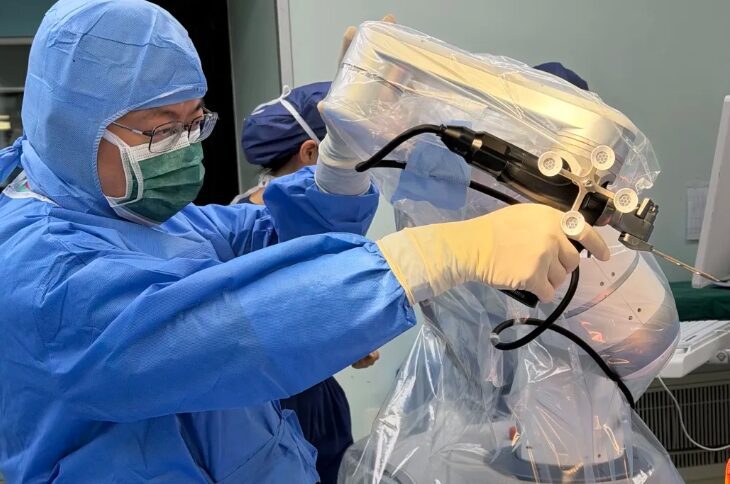
The KUNWU® comprehensive orthopaedic surgical robot, which was independently developed by Yuanhua Robotics, Perception and AI Technologies Ltd. (henceforth referred to as “Yuanhua Tech”), helped orthopaedic surgeon Dr. José Roberto Pengo Junior perform a left total knee replacement on a 73-year-old female patient. The patient’s lower limb alignment was precisely restored, attaining the anticipated clinical result of the surgery, according to postoperative plain X-ray images.
Launch in Public Hospital Tests Real Clinical Capability
Getting international registration clearance is only the first step in the market access process for medical device companies; the real test always happens in hospitals. In Brazil, Santa Casa de Jaú is a representative public health facility. Before agreeing to use the KUNWU® system for robot-assisted surgery, the hospital’s staff thoroughly assessed the system’s planning capabilities, navigation accuracy, and compatibility with the current clinical workflow.
Interestingly, a local Brazilian prosthesis brand was used throughout the procedure. As a true clinical test of its open-platform capabilities, KUNWU® had to finish preoperative planning, bone cutting execution, and intraoperative navigation under a completely new framework of prosthesis data. Dr. Pengo Junior, the primary surgeon, said after the procedure that the system’s data matching performance with the local prosthesis was satisfactory. He went on to say that physicians can benefit much from being able to choose a well-known prosthesis brand on their own.
Open Architecture Addresses Market Pain Points
The majority of popular international products in the field of orthopaedic surgical robots are closely associated with particular prosthesis brands. As a result, hospitals’ options for prosthesis are essentially limited when robot-assisted surgery is implemented. Local prosthesis brands frequently have clear advantages in terms of pricing and supply chain efficiency for developing countries like Brazil and Southeast Asia. When dealing with closed-architecture robots, these benefits are challenging to utilise.
KUNWU® is compatible with the parameter databases of different prosthesis companies and has an open-platform design that facilitates data integration from several implant brands. Surgical planning, bone cutting execution, and postoperative alignment all reached the anticipated degree of precision throughout this procedure, and the system fully adapted to the local prosthesis data. According to industry insiders, an orthopaedic robot’s ability to genuinely integrate into the clinical ecosystem of nearby hospitals is directly determined by its open prosthesis compatibility. This is a crucial differentiator in the competitive race to gain traction in emerging markets.
Technological Prowess Underpins Clinical Performance
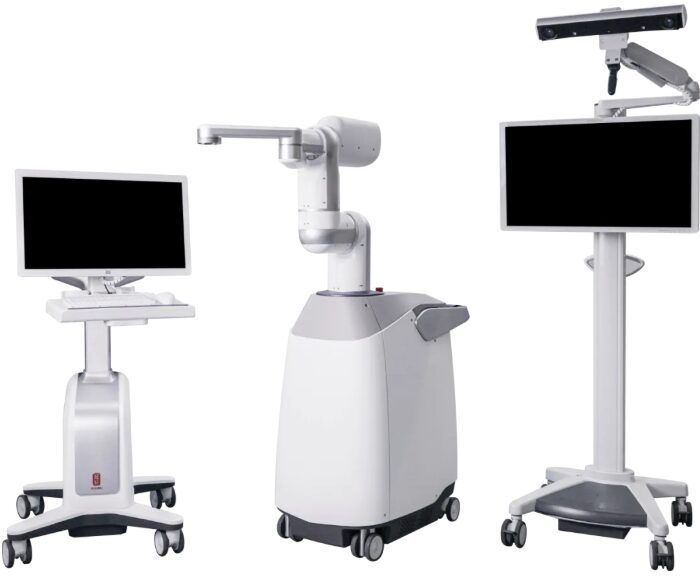
A main control cart, a navigation cart, and a robotic arm cart make up the “three-cart collaborative” design used by KUNWU®. In order to undertake a quantitative study of the lower limb alignment and the bone cutting range before the surgery, the technology creates a 3D reconstruction based on the patient’s CT images.
The robotic arm limits its motions within safe bounds, maintaining execution precision at the sub-millimetre level, while the intraoperative navigation system continuously tracks changes in the anatomical structure at a high refresh rate of 335 Hz. Additionally, the system has real-time intraoperative gap quantification capabilities that effectively lower the risks of postoperative prosthesis loosening and revision surgery by converting soft tissue balancing judgments—which historically relied on experience—into quantifiable data references.
International Expansion Continues to Accelerate
The foundation established by Yuanhua Tech’s ongoing development of its global layout in recent years supports the successful clinical launch of KUNWU® in a Brazilian public hospital. KUNWU® recently earned the EU MDR certificate from BSI and has received registration approvals in several nations and regions, including Brazil. The industry views this certification as one of the strictest medical device regulations in the world today, and many foreign institutions use it as a crucial guide for assessing product credentials.
Regarding its international strategic layout, Yuanhua Tech created a dual-headquarters layout that propels the synergistic development of its Shenzhen R&D centre and Hong Kong international window by establishing its international headquarters in the Hong Kong Science Park in 2022 and obtaining the “Hong Kong Brand” certification in 2024. As of right now, KUNWU® has created seven main clinical centres and has amassed over 6,000 clinical cases domestically, covering a variety of orthopaedic scenarios, including joints, spine, and trauma.
KUNWU® has officially entered real-world clinical application settings in international hospitals following the conclusion of this procedure in Brazil. According to Yuanhua Tech, the business would keep encouraging market partnerships in areas including South America, Europe, and Southeast Asia. KUNWU®’s open architecture will let it maintain its distinct place in a variety of prosthesis ecosystems and clinical practices across global markets.
Picture Source: Yuanhua Tech