
New Medical School -HKUST Begins Preparations
Developing Clinically Proficient and Technologically Adept Physicians of the Future
A new medical school at Hong Kong University of Science and Technology (HKUST) is being planned with HKSAR Government support. The School will strengthen the local healthcare infrastructure and promote Hong Kong’s role as a worldwide centre for medical education, research, and innovation by training a new generation of technologically capable doctors.
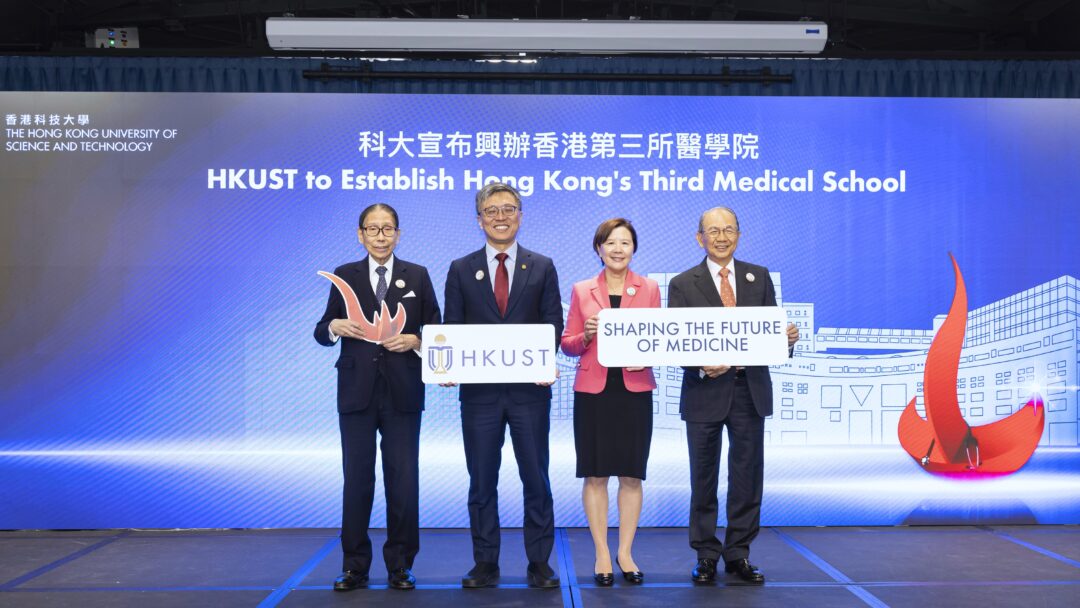
HKUST Council Chairman Prof. Harry SHUM (second left), President Prof. Nancy IP (second right), Chairman of the Council Advisory Group Dr. the Hon. LEONG Che-Hung (first left) and Chairman of the Planning Committee for the New Medical School Dr. Michael MAK Hoi-Hung (first right).
HKUST Council Chairman Prof. Harry SHUM said, “HKUST’s third medical school preparations are a milestone. Addressing Hong Kong’s changing healthcare requirements with this project will strengthen and sustain the healthcare system. HKUST thanks the HKSAR Government’s Task Group on New Medical School for its thorough review of the proposal and the many experts, intellectuals, and community people who have supported it for two years.”
Sharing resources
Prof. Shum noted that HKUST looks forward to working closely with the University of Hong Kong and Chinese University of Hong Kong medical faculties. These agreements will boost medical education and research in the city by sharing resources and using complementary skills. He noted that Hong Kong Baptist University and The Hong Kong Polytechnic University have strong foundations in Chinese medicine, allied health, and nursing, respectively, offering significant opportunities for comprehensive collaboration to improve and diversify Hong Kong’s healthcare education landscape.
HKUST President Professor Nancy IP thanked the Chief Executive, Secretary for Health, and Secretary for Education for their continued support. “The HKSAR Government has shown a visionary foresight in establishing Hong Kong as an international hub for scientific research and medical education, actively supporting the national goal of building China into a leading country in education,” she stated. “HKUST actively supports the government’s strategic initiatives, including Northern Metropolis development. The new medical school is crucial to ‘the 2024-2035 Master Plan on Building China into a Leading Country in Education.’ It will boost Hong Kong’s goal of world-class universities and fields. Using the Northern Metropolis University Town as a strategic platform, we hope to strengthen industry-academia-research collaboration and develop top healthcare and technology talent for Hong Kong and the nation.”
Interdisciplinary approach
“HKUST values multidisciplinary education and research and scientific research. The HKUST School of Medicine will focus on ‘integrating engineering and medicine through research.’ Prof. Ip noted that an interdisciplinary approach will improve students’ clinical competence and technology proficiency while imparting professional ethics, empathy, and a patient-centered attitude throughout the curriculum.
We train medical professionals who excel in clinical practice and have a forward-looking vision for technology innovation to meet the increasingly complicated healthcare challenges of the future. The School will accelerate medical research and clinical application. “We will shape Hong Kong healthcare by combining technological advancement with deep humanistic care,” she said.
Prof. Ip said HKUST will position itself differently from Hong Kong’s two medical schools to maximise its institutional assets. HKUST ranks first in Hong Kong and 17th internationally in data science and AI, she said. She stressed that future doctors must understand technology and artificial intelligence’s advantages and disadvantages in order to use them in clinical practice.
Prof. Ip added: “With a 50-student inaugural cohort and a campus expansion plan underway, we are confident in our campus readiness. Curriculum preparation began early in planning and is advanced. Despite the ambitious deadline, we are certain that the government and Task Group will guide us to complete all preliminary work on time.
Student recruitment, funding -with global admissions by 2027
The early reaction to faculty recruiting is promising. We got expressions of interest from 36 renowned medical professors in the US, Europe, Singapore, and Australia—many of whom have strong ties to Hong Kong—before conducting a global search.
Equally bullish on student recruiting. HKUST is one of Hong Kong’s most international colleges, attracting top local and international talent to boost the city’s healthcare workforce. Signing a memorandum of understanding with the government is our next move to accelerate preparations.”
Professor Ip said that HKUST will initially provide a four-year graduate-entry Bachelor of Medicine and Bachelor of Surgery (MBBS) degree. About 50 local and non-local students will be in the initial cohort. The program accepts applications from medically passionate people with bachelor’s degrees in science or healthcare from prominent Hong Kong or international universities.
Global admissions should begin by 2027, with the first cohort starting in 2028/29. The curriculum, benchmarked against top medical institutions worldwide, meets Hong Kong’s healthcare needs and includes medical research training. This ensures graduates have the professional and clinical abilities to meet Medical Council of Hong Kong standards.
HKUST’s new medical school will include a world-class, varied, and prominent faculty in clinical and non-clinical fields. In addition, a global recruitment campaign is ongoing to recruit top international specialists and leaders, including the founding dean. Honorary and adjunct faculty from clinical service partners are also being appointed by the University. These appointees will shape the medical school’s strategic direction, curriculum, and teaching and research initiatives.
Prof. Shum was optimistic about the University’s fundraising. He remarked, “We appreciate people who support HKUST School of Medicine’s educational vision and donate generously. Due to its debt-free status and large budgetary reserves, HKUST is financially stable. The University has committed to investing HK$7 billion over 25 years—an average of HK$300 million annually—in the medical school’s development. Academic programs will receive recurrent financing from the HKSAR Government’s University Grants Committee. The public works program will subsidise the medical school’s campus construction in the Ngau Tam Mei New Development Area and provide the School with education and research facilities. This strong public-private cooperation will provide adequate resources for medical school development and operation.”
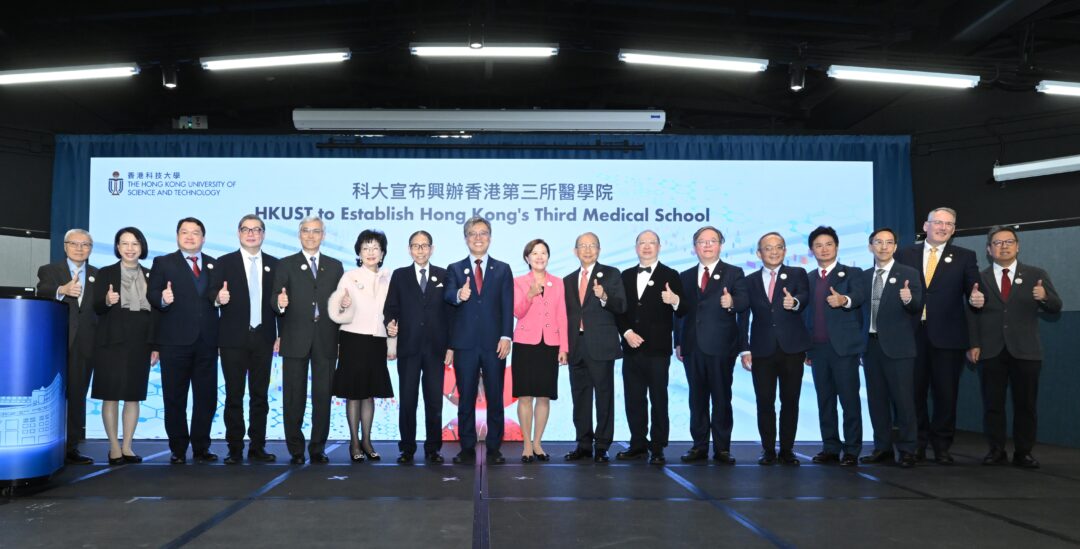
(from left) Dr. MOK Kin-Ying, Clinical Professor of Division of Life Science; Ms. Yvonne HO, Associate Vice-President (Projects); Ir. John KWONG, Vice-President for Development; Prof. TAM Kar-Yan, Vice-President for Administration and Business; Mr. Stephen Yiu; Ms. Edith Shih; Dr. the Hon. Leong Che-Hung; Prof. Harry Shum; Prof. Nany Ip; Dr. Michael Mak; Prof. Raymond Liang; Prof. Guo Yike; Prof. Tim CHENG Kwang-Ting, Vice-President for Research and Development; Prof. Charles NG, Vice-President for Institutional Advancement; Prof. WONG Yung-Hou, Dean of Science; Prof. Russell Lindsay GRUEN, Associate Provost (Health and Medical Sciences); and Prof. Hong LO, Dean of Engineering.
Location & Strengths
The HKUST School of Medicine will originally be located at the University’s Clear Water Bay campus in a medical research and education building. After the Ngau Tam Mei Development Area is completed, the School will move to the University Town next to the smart hospital. The School will collaborate with the San Tin Technopole in the Northern Metropolis and the University Town to advance the Greater Bay Area.
HKUST, one of the Times Higher Education’s Most International Universities, uses its high internationalisation and global network to attract top medical educators and researchers from Hong Kong, the Chinese Mainland, and abroad.
The University is constructing a medical school that blends clinical excellence with technological innovation, building on its leadership in AI, data science, and robots. It will train a new generation of doctors that value ethics, patient-centered care, and technology integration, changing healthcare.
HKUST’s thriving innovation and technology ecosystem and strong translational research capabilities will accelerate medical research from lab to clinic and commercialisation. This strategy could improve primary, precision, and customised healthcare.
Since declaring its plan to open the city’s third medical school in early 2024, HKUST has actively pursued clinical internships, curriculum development, talent development, academic exchanges, and collaborative research. About 40 prestigious medical schools, institutions, and hospitals from Hong Kong, mainland China, and abroad have signed relationships with the University. Hong Kong Sanatorium & Hospital, Hong Kong Adventist Hospital, Peking Union Medical College Hospital, Huashan Hospital affiliated with Fudan University, Ruijin Hospital, Shanghai Jiao Tong University School of Medicine, and The First Affiliated Hospital of Sun Yat-sen University are hospital partners.
Peking, Tsinghua, Fudan, Zhejiang, UC San Diego, Imperial College London, University College London, King’s College London, Karolinska Institute, KTH Royal Institute of Technology, and Edinburgh Universities are medical school partners.
Picture Source: HKUST